Bridging Worlds: From Kampala Classrooms to Colorado’s Front Lines of Water
When Lynate Wanyana walked into her math and physics classrooms in Uganda, she was often the only woman in the room. She didn’t see that as a problem. She loved numbers, problem-solving and the precision of engineering. Yet one early experience revealed just how determined she would need to be to claim her place in a male-dominated field — and, eventually, to build a flourishing career a continent away in Colorado.
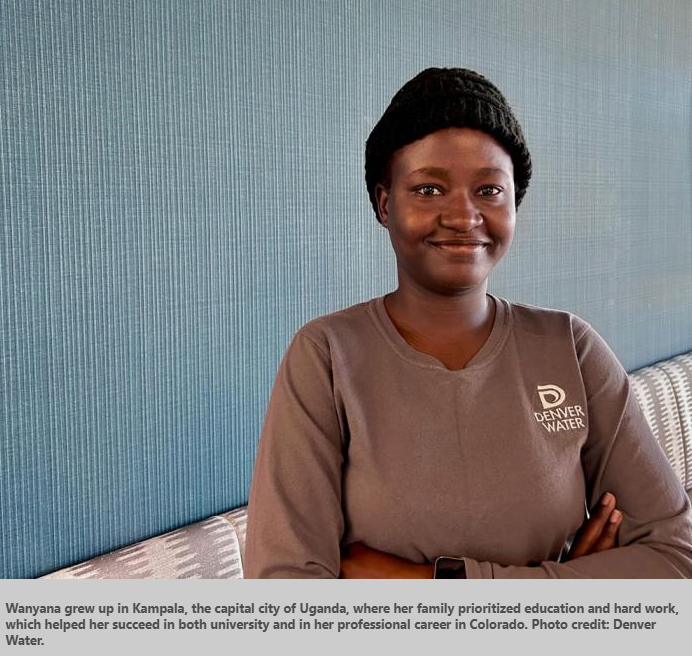
When Lynate Wanyana walked into her math and physics classrooms in Uganda, she was often the only woman in the room. She didn’t see that as a problem. She loved numbers, problem-solving and the precision of engineering. Yet one early experience revealed just how determined she would need to be to claim her place in a male-dominated field — and, eventually, to build a flourishing career a continent away in Colorado.
During a university-era survey internship, the men were sent to the field to gain the hands-on experience that is essential in geomatics and surveying. The women were left behind. Lynate spoke up. She told her female supervisors she wanted to work in the field. Their response became a defining lesson: “Claim your place.” If she did not ask, she realized, she would be overlooked. From then on, she decided she would speak up for the opportunities she wanted.
That decision would carry her far beyond Kampala.
Raised in Uganda’s bustling capital, in a family where education and responsibility were nonnegotiable, Lynate grew up in a house full of activity — an older sister, two younger brothers, a mother in hotel marketing, and a father who worked as a construction contractor and land broker. Listening to her father talk about surveyors on his projects sparked her interest in the field. She followed that spark through demanding coursework in geomatics engineering at Ndejje University, diving into the world of location data, mapping and measurement.
Her hard work paid off. Not only did she thrive academically, she was recognized as the overall best female student at the university the year she graduated. When her name was called at the awards ceremony, it was mispronounced — she didn’t even realize at first that she had won. But the award symbolized the same message she had heard as an intern: she belonged in spaces where she wasn’t expected, and her performance could speak for itself.
Even before she boarded a plane, Lynate dreamed of seeing more of the world. Movies and online videos became her window into places she might never visit. When she eventually did travel, those images made far-off cities and landscapes feel just a little more familiar. That mattered when, having never been outside Africa, she made her first international journey alone.
Lynate left Uganda in 2020 to join her husband, who was already living in Colorado. Her route took her through large international airports she’d only seen on screens. She navigated them with the same persistence that had helped her through engineering classes: asking questions, double-checking directions, refusing to let uncertainty stop her.
She landed in Denver in March 2020 — on one of the last flights to arrive before the global pandemic brought air travel to a halt. Her new home was an apartment in a state she knew only from movies, her husband away on a construction job, her closest sibling several states away in Texas. In that quiet, she understood that no one was going to build her new life for her. She would have to claim it.
Although she spoke English, everyday American language was unfamiliar. So she took a job at a grocery store, a place where the aisles became both a classroom and a community. She learned new words: the names of unfamiliar vegetables, the endless varieties of bread, the American cuts of meat that bore little resemblance to what she knew back home. Just as importantly, she learned how to speak so she could be heard.
Sometimes she had to repeat herself three times for customers to understand her accent. The experience went both ways — she was learning new slang and rhythms, while others were learning to listen more closely. Day by day, she sharpened her communication skills, building a confidence that would serve her well when she decided it was time to return to her chosen field.
All the while, Lynate was looking for a way to turn her degree into a career in Colorado. She reached out to surveyors back in Uganda to see if they had any contacts in the U.S. She scoured company websites and professional networking platforms, studying the local industry and sending inquiries whenever she could. But the pandemic had frozen hiring in many firms, and application after application went unanswered.
As the months dragged on, she considered abandoning surveying in favor of whatever work she could find. Then one of the surveyors she had contacted — a respected figure at a Denver-area company — wrote back with a simple, game-changing suggestion: try the local utilities. They still needed people with technical expertise, even in uncertain times.
Following that advice, she turned her attention to Denver’s major utility employers. One, in particular, stood out: Denver Water. When she discovered they were hiring, she applied. The call inviting her to interview felt like a breakthrough. The excitement, however, was tempered by doubt. Would the skills and methods she had learned in Uganda translate to U.S. standards and equipment?
Before the interview, she wrestled with those questions. Then she logged on, met the team and found that every question they asked her was within her reach. The fundamentals of surveying, it turned out, had prepared her well. Her education and field experience weren’t a disadvantage; they were a strong foundation. The conversation that she had approached with anxiety became a chance to show what she already knew.
She got the job.
Lynate joined Denver Water in June 2021 as a survey technician, at a time when many organizations were still cautious about hiring. Her work quickly began taking her to places she had once only imagined: high in the mountains, alongside reservoirs and dams, deep into the network that keeps water flowing from Colorado’s snowfields to taps in homes and businesses across the region.
For a woman who had long wanted to be out in the field, the role felt like the fulfillment of an early promise to herself. She learned to drive the large pickup trucks her team uses to reach remote job sites. She became familiar with the twists and turns of the Denver metro area, as well as the roads that wind through Colorado’s rugged terrain. Each new assignment offered another chance to expand her skills and see more of the state she now calls home.
Her colleagues appreciated her work ethic and curiosity. When they told her how excited they were to have her on the team, she often felt an even deeper gratitude. This was the kind of opportunity she had once worried she might never find.
Not content to stop there, Lynate continued to invest in her own growth. She enrolled in a master’s program in Geographic Information Systems at the University of Denver, using Denver Water’s tuition reimbursement program to deepen her expertise. Balancing demanding field work, advanced coursework and life in a new country required the same discipline her parents had instilled in her in Kampala — the evenings spent on homework, the strict expectations, the insistence that responsibilities came first.
When she talks to her parents now, she shares stories of mountain sites, complex projects and the satisfaction of seeing her work contribute to a critical public service. They, in turn, feel the pride of seeing their daughter claim the opportunities they always wanted for their children. The girl who once had to insist on going to the field as an intern is now a professional shaping one of Colorado’s most essential systems.
Looking ahead, Lynate’s ambitions remain clear. She wants to keep learning, to be useful to her team, and to climb the ladder when the chance arises. She values working in an organization that prioritizes growth and work-life balance, and she imagines a future in which she is still with Denver Water decades from now, contributing at even higher levels.
Her story is both uniquely her own and emblematic of something larger. It is a story of a young woman who refused to be sidelined, who moved across continents in search of opportunity, and who built a new life not through luck, but through persistence, preparation and the courage to ask for what she wanted. It is also a reminder that the flow of talent and determination from places like Kampala to cities like Denver enriches the communities on both ends of the journey.
Editor's Note: Story first appeared on Denver Water Website and adapated from https://www.denverwater.org/tap/uganda-colorado-opportunities-and-adventures